
You send the card company $50. Next month, the balance has fallen by $10.
The payment went through. You made no new purchases. Yet most of the money bought another month of borrowing, rather than much progress toward being finished.
That is the central reason a credit-card balance can barely move: the payment has to outweigh the interest, fees and new spending added to the account before the amount owed meaningfully falls. Paying every month tells you something about regularity. It doesn’t tell you how quickly the debt is disappearing.
The arithmetic below uses dollars and a hypothetical US-style revolving balance. The underlying repayment logic travels across currencies; the statement rules and account terms discussed here are specifically US ones.
Where the first $50 goes
Suppose you owe $2,000 at a constant 24% annual percentage rate, or APR. For a simple illustration, divide that rate by 12: 2% a month.
The first month’s interest is $40. Pay $50 after that interest is added, and the balance becomes $1,990. Of the $50 leaving your bank account, $40 meets the interest charge and $10 reduces the debt you carried into the month.
Principal is the money borrowed; interest is the charge for borrowing it. On a revolving account, unpaid charges can also become part of the balance. What matters for progress is the reduction in the total amount still owed.
Now keep everything the same but pay $100. The interest is still $40, leaving $60 to reduce the balance. Doubling the payment has multiplied the first month’s debt reduction by six.
That result isn’t a special offer. It’s what happens when the original payment sits only a little above the interest charge.
Two payments, two very different finish lines
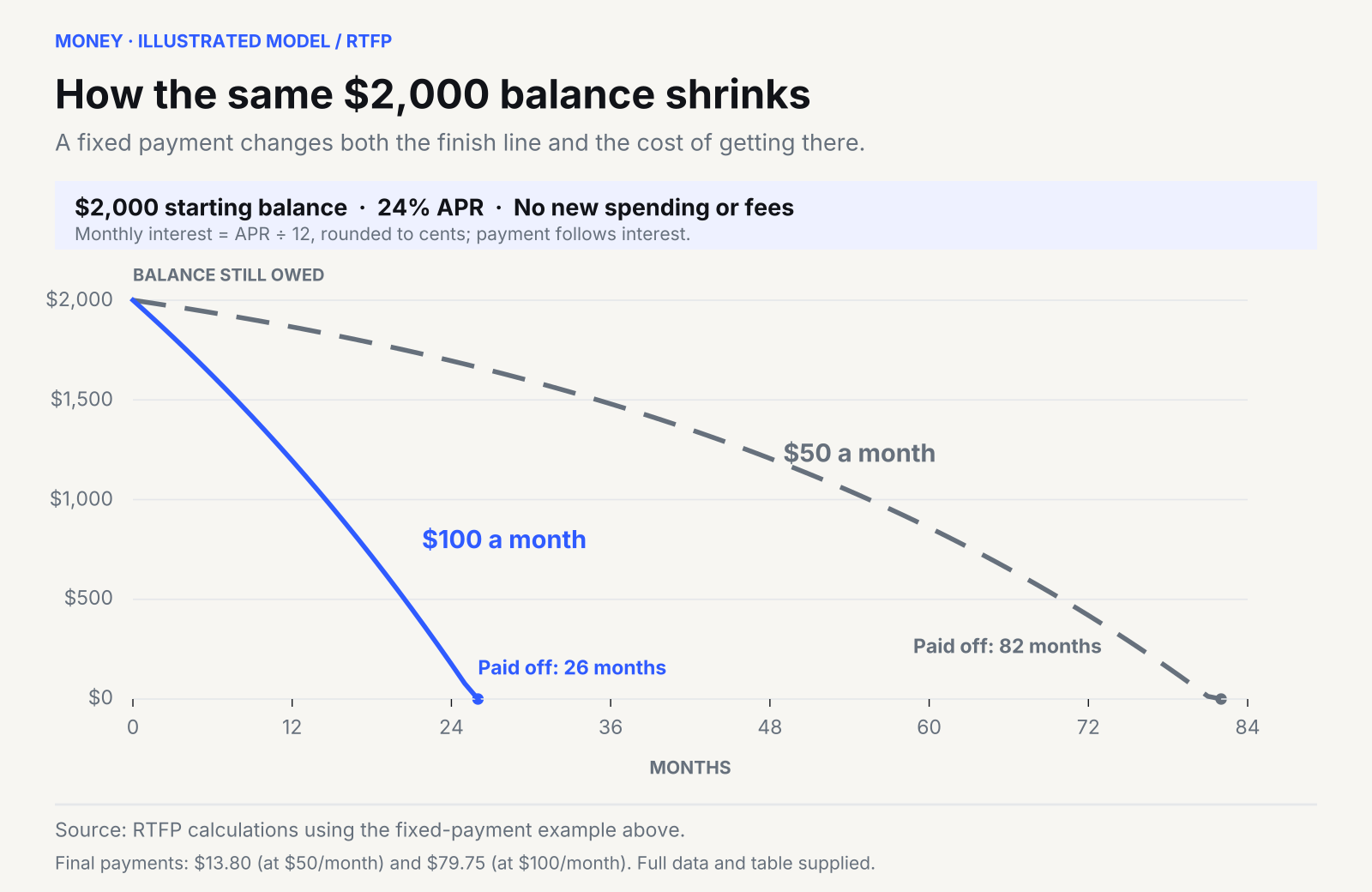
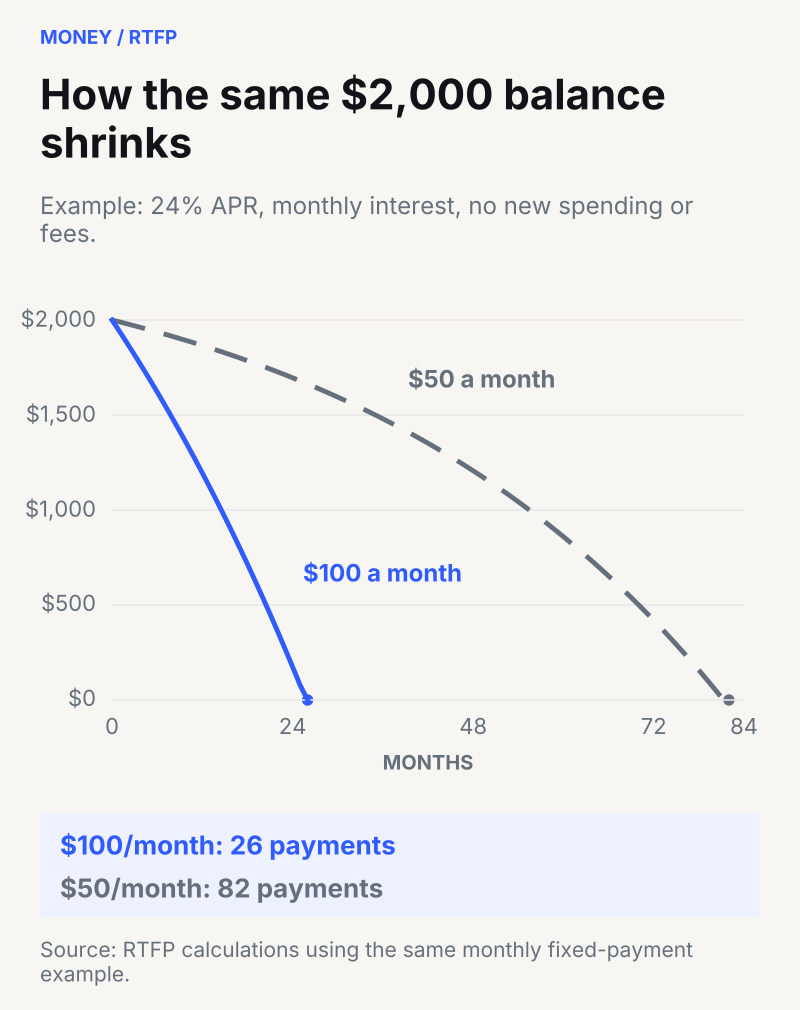
Here is that example carried through until the balance reaches zero.
Example assumptions: $2,000 starting balance; constant 24% APR; monthly interest at APR divided by 12, rounded to the nearest cent; interest added before each month-end payment; no new purchases or fees. Payments stay at $50 or $100 until a smaller final payment clears the account. These are chosen fixed payments, not an issuer’s minimum-payment formula.
| What happens | Constant $50 payment | Constant $100 payment |
|---|---|---|
| First month’s interest | $40.00 | $40.00 |
| First month’s balance reduction | $10.00 | $60.00 |
| Balance after 12 payments | $1,865.89 | $1,195.28 |
| Number of monthly payments | 82 | 26 |
| Final payment | $13.80 | $79.75 |
| Total paid | $4,063.80 | $2,579.75 |
| Total interest | $2,063.80 | $579.75 |
At $50 a month, a year’s payments total $600, but the debt has fallen by only $134.11. At $100, the first year’s $1,200 of payments cuts the balance by $804.72.
Across the whole repayment period, the larger payment saves $1,484.05 in interest and finishes 56 months sooner. The smaller-payment borrower ends up paying more in interest than the original $2,000 borrowed.
The improvement builds on itself. A lower remaining balance produces a smaller interest charge next month. With the payment held steady, more of it can reduce the balance, which lowers the next interest charge again.
Why the minimum can keep the finish line distant
A minimum payment is the amount required for that billing period. It can be much smaller than a payment that clears the debt on a short timetable.
The formula matters. One published Chase cardmember agreement, for example, generally uses the greater of $40 or 1% of the applicable new balance plus billed interest and late fees, with separate additions for past-due amounts and certain financing arrangements. That is an example of a contract, not a universal rule.
When the minimum depends on the balance, it can fall as the balance falls, until a floor takes over. Following that shrinking amount gives up some of the acceleration you get by keeping a payment constant.
This is why the $50 comparison above must not be read as a forecast for “paying the minimum.” An actual minimum could start higher, change every month, or include other obligations. The agreement and statement determine it.
In the US, statements generally include a minimum-payment warning and an estimate of repayment time and cost. They also generally show a payment that would clear the statement balance in 36 months, subject to exceptions. Those disclosures assume no further charges. The CFPB’s periodic-statement rules explain the requirements.
Real accounts have another moving part
Our example charges interest once a month to make the mechanism visible. Many issuers instead calculate interest using daily balances. Payment timing, billing-cycle length and the account’s calculation method can therefore change the exact bill. Where interest is accruing daily, reducing the balance earlier can reduce the interest charged, as the CFPB explains.
New spending changes the picture too. In the first $50 month, the debt falls by $10. Add a $30 purchase after that modeled payment and the account ends at $2,020, even before any interest on the new purchase. You paid on time and still owe more.
A purchase grace period can complicate this further. Many US cards allow qualifying purchases to avoid interest when the balance is paid in full by the due date. Carrying a balance can mean losing that grace period, so new purchases may accrue interest from their transaction dates. Cash advances generally work differently. The CFPB’s grace-period guide describes the distinction.
What each side is measuring
For the cardholder, the useful measure is debt reduction. Compare consecutive statements, then account for purchases, fees, interest, payments and credits. That separates the cost of existing borrowing from fresh spending. An on-time payment and a falling balance answer different questions.
For the issuer, a carried balance generates interest revenue. A small required payment offers the customer flexibility while allowing borrowing to continue. That creates an economic tension: a manageable payment today can support a long, costly repayment period. It doesn’t establish that every minimum-payment formula has the same motive or effect.
For investors, interest revenue isn’t profit. Funding the loans, operating the business and absorbing credit losses all cost money. The Federal Reserve’s analysis of credit-card profitability separates these components. A rising balance may represent more earning assets, but its value depends on whether borrowers can repay.
The number to understand on your own statement is how much of this month’s payment survives the month’s additions to the balance. In our $50 example, that number starts at $10. Once you see it, the apparently motionless balance becomes much easier to explain.